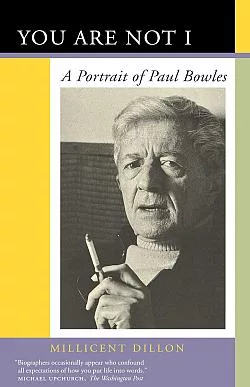
You Are Not I: A Portrait of Paul Bowles
The famously enigmatic writer-composer Paul Bowles is the subject of Millicent Dillon's unforgettable new book. Her portrait of the chameleonlike artist is much more than an account of Bowles's life, however. It is also a meditation on biography that questions the biographer's role, the subject's credibility, and the very nature of "truth" in the telling of a life.
Millicent Dillon first met Paul Bowles in Tangier in 1977, when she was writing a biography of his wife, the author Jane Bowles, who died in 1973. Dillon returned to Morocco in 1992 to work with Bowles on a book about his own life. In Bowles's book-lined apartment often crowded with visitors, Dillon observes the magnetism the aging artist exerts on anyone who comes into his circle. Bowles talks of his difficult childhood and of his grief over Jane's long illness, of exile, dreams, and madness. He is charming and evasive with Dillon, generous and devious. As the book unfolds, Dillon's own reflections and concerns surface alongside details of Bowles's daily life, his physical condition, his interactions with others. Her portrait of the artist is seen simultaneously with her construction of that portrait, and in a kind of literary legerdemain we are able to observe Dillon on the biographical canvas along with Bowles and his deceased wife.
Millicent Dillon first met Paul Bowles in Tangier in 1977, when she was writing a biography of his wife, the author Jane Bowles, who died in 1973. Dillon returned to Morocco in 1992 to work with Bowles on a book about his own life. In Bowles's book-lined apartment often crowded with visitors, Dillon observes the magnetism the aging artist exerts on anyone who comes into his circle. Bowles talks of his difficult childhood and of his grief over Jane's long illness, of exile, dreams, and madness. He is charming and evasive with Dillon, generous and devious. As the book unfolds, Dillon's own reflections and concerns surface alongside details of Bowles's daily life, his physical condition, his interactions with others. Her portrait of the artist is seen simultaneously with her construction of that portrait, and in a kind of literary legerdemain we are able to observe Dillon on the biographical canvas along with Bowles and his deceased wife.
Komentáře
Přihlas se, abys mohl/a přidat komentář.


Zatím žádné komentáře. Buď první!